Why a Routine Needs a Cue Before It Needs More Willpower
A routine cue makes it easier to begin by linking one small action to a signal already in your day, such as closing your laptop or boiling water.
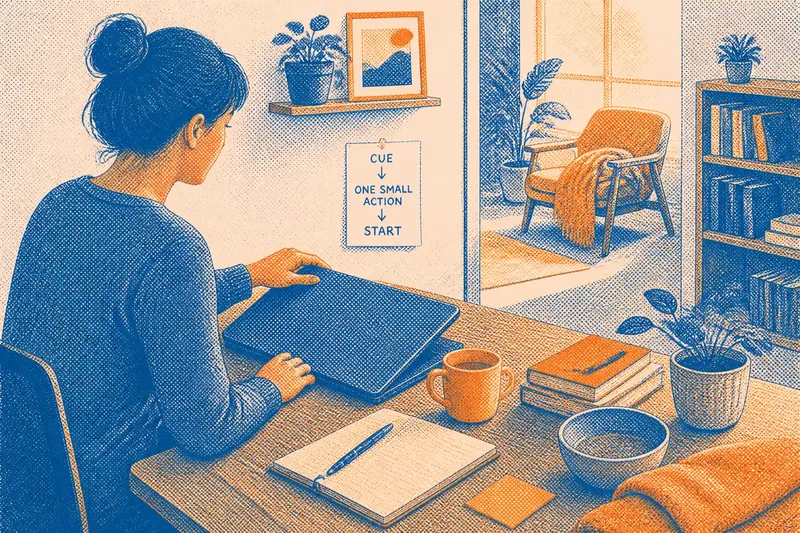
How do you get a routine started when you keep forgetting or putting it off? A routine cue gives the action a clear place in your day, so beginning depends less on remembering to feel motivated. The useful change is often not a bigger plan but a reliable signal followed by one small action.
What is a cue for a routine?
A cue is an event you can notice that tells you it is time to begin a particular action. It might be a regular activity, a change of place, a sound, or an object you encounter. “After I put my lunch dishes in the sink, I’ll read one page” uses a cue that already occurs; “I’ll read when I have time” does not identify one.
A cue is different from a goal. “Learn Spanish” names a direction, while “after I pour my morning coffee, I’ll review one phrase” connects a manageable action to a moment. The cue answers when to start; the action answers what to do.
Choose something that is observable and reasonably predictable. A phone alarm may work if you reliably notice it, but a recurring action—closing your laptop at the end of work, for example—can fit more naturally into a day that does not run on a fixed schedule.
Why can a cue help more than extra willpower?
Without a cue, you have to remember the routine, decide when to do it, and negotiate with yourself each time. That leaves several chances to postpone it. A clear signal reduces the number of decisions between noticing the moment and starting.
This does not mean motivation or effort never matter. A cue cannot create time, remove a real obstacle, or make an unwanted task meaningful. It can, however, make a chosen action easier to recognize amid ordinary distractions.
Think of a cue as a prompt, not a command. If the signal arrives while you are driving, caring for someone, or handling an urgent task, beginning later may be sensible. The point is to make the next suitable opportunity easier to identify, not to obey a schedule regardless of circumstances.
How do you choose a cue that already exists?
Look for a repeated moment that happens before the routine could reasonably begin. It should be specific enough to recognize, stable enough to recur, and close enough to the action that you do not need to remember a separate chain of instructions.
- Notice existing transitions. Examples include setting down your work bag, washing a breakfast bowl, or finishing a regular call.
- Check whether the moment is dependable. If a commute or meeting changes often, it may be a weak cue. A recurring action at home might be more reliable.
- Choose a cue you can notice. A notebook on your desk may be easier to see than a reminder buried among phone notifications.
- Make sure the action can follow. If the cue occurs in a place where the routine is impractical, choose a different signal or a smaller action.
- Keep the connection simple. One cue followed by one action is easier to recall than several conditions, exceptions, and backup plans.
Say you want to stretch during the workday but often remember only after leaving your desk. Imagine choosing the moment you close your laptop after lunch as the cue, then doing one gentle shoulder roll beside the desk. The observable result you are aiming for is a clear start linked to a familiar transition; you can decide later whether to continue.
How small should the action be?
Make the first action small enough to begin under ordinary conditions, not so ambitious that it requires a special mood or a free afternoon. For reading, it could be opening the book and reading a page. For drawing, it could be placing a pencil on paper and making one mark.
A small start is not a promise to do only that amount forever. It is a low-friction entry point. Once you begin, you may continue, but the routine still counts as started if you stop after the action you chose.
It helps to distinguish the starting action from the full activity. “After I put my lunch container away, I’ll open my sketchbook” is easier to make concrete than “After lunch, I’ll become more creative.” The first states something you can do and observe; the second leaves the starting point unclear.
How do you make the cue and action easy to remember?
Write the connection as a direct sentence: “After [cue], I will [small action] at [place], if that place is useful.” Keep the wording plain. You are making the link easy to retrieve, not composing a motivational slogan.
Prepare the immediate surroundings so the action can follow the cue. Put the book beside the chair where you finish your tea, leave a notebook open on the desk, or keep the walking shoes near the door you use. Preparation should remove a small obstacle rather than become a new project.
If an object is the cue, make sure you encounter it at the intended moment. A water bottle left in a cupboard is unlikely to prompt a brief pause. A bottle on your desk, by contrast, may catch your attention when you sit down. Keep the setup safe and practical for the space.
What if the cue keeps arriving at the wrong time?
Adjust the cue or the action rather than treating every missed start as a failure of character. If the moment is routinely crowded, select a calmer transition. If the setting is unsuitable, shrink the action to something that can happen there or move the routine to a more workable place.
Separate an unreliable signal from an unreliable response. If you never notice an alarm, the signal may be poorly chosen. If you notice it but cannot start because the materials are elsewhere, the action needs a simpler setup. Naming the obstacle points to a practical adjustment.
Try the revised connection in the next ordinary opportunity. Avoid changing the cue, action, time, and location all at once unless the current setup is plainly unworkable; changing one part makes it easier to see which part was causing friction.
What do people ask about routine cues?
Can I use an alarm as a cue?
Yes, if you reliably notice it and can act when it sounds. If alarms blend into other notifications or arrive during busy periods, attach the routine to a more visible daily transition instead.
Should the cue happen at the same time every day?
No. A repeated event can be more useful than a fixed clock time if your days vary. Choose a cue that tends to happen before the action is possible, and allow for days when the event does not occur.
What if I miss the cue?
Resume at the next suitable opportunity rather than trying to compensate with an oversized session. If missing the signal is common, reconsider whether you notice it and whether it happens at a workable moment.
How long should I keep the same cue?
Keep it while it remains noticeable and practical. If your schedule or surroundings change, update the connection so it still points to a real moment in your day.
What is not worth the effort?
Do not spend a long time designing an elaborate tracker, choosing a perfect phrase, or assigning a cue to every part of the day before trying one routine. A brief note and a visible reminder may be enough to start. The routine should be the work; maintaining the system around it should stay light.
Also avoid turning a missed cue into a reason to add more rules. A complicated sequence can make the start harder to remember. Keep the useful parts: one recognizable signal, one small action, and a setting where that action can happen.
How do you know when to revise the connection?
Pay attention to what you can observe: whether the cue occurred, whether you noticed it, and whether the action was feasible. If the cue occurred but you did not see it, make it more visible or choose another. If you saw it but lacked time or materials, change the action or its setting.
Routine cues work best as practical supports, not tests of discipline. Start with one existing signal and one small action; then refine the connection when your ordinary day gives you a clear reason to do so.