A Ten-Minute End-of-Week Review That Leaves You with One Next Step
An end-of-week review helps you notice progress, name one snag, and choose a clear next step without turning reflection into another long task.
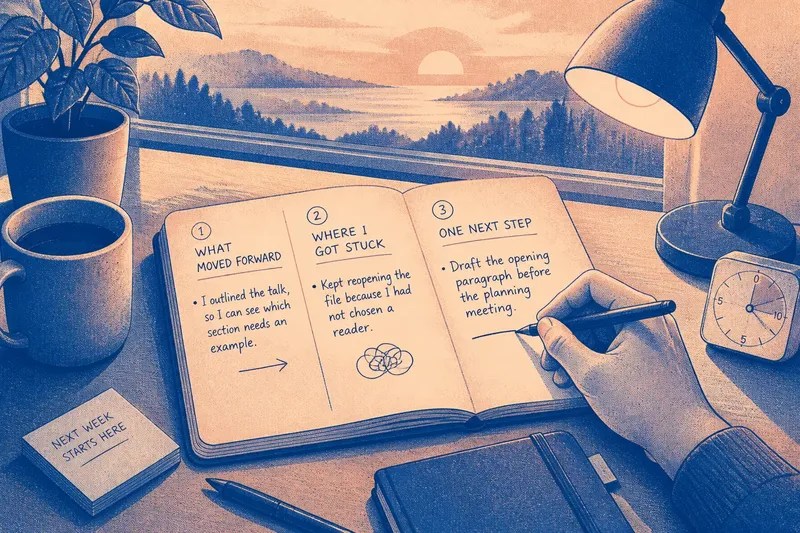
What should you carry from this week into the next, and what can you leave behind? An end-of-week review can answer that in ten minutes: notice progress, name a snag, and choose one action. Use a notebook, a calendar, or a blank note on your phone; the value is in making a small, honest record, not in finding the perfect tool.
Set a timer for ten minutes and work through the three prompts below. Keep your answers brief enough to read back next week. This is a pause for orientation, not a weekly performance report.
Start with evidence of progress
Ask: What moved forward this week, even slightly? Look for something you did, made, understood, or decided. A completed task is one kind of progress, but so is an early attempt that clarified what the task requires.
Memory tends to favor the unfinished item still taking up space in your head. Check your calendar, sent messages, task list, or the document you worked on to jog it. You are looking for observable evidence, not a reason to congratulate yourself.
Write one sentence that names both the action and its effect. “I outlined the talk, so I can see which section needs an example” is more useful than “I was productive.” The first tells you what changed and gives you a starting point later.
If the week felt scattered, count a useful decision as progress. Perhaps you postponed a request until you had the necessary information, or noticed that a plan was too vague to act on. A clearer picture of the work can matter even when the visible task remains unfinished.
Name the snag without turning it into a verdict
Ask: Where did I get stuck, and what made the next move difficult? Describe the point of friction as specifically as you can. “I avoided the draft” leaves the cause hidden; “I kept reopening the file because I had not chosen a reader” gives you something to respond to.
Keep the description close to what happened. The aim is not to diagnose your personality or produce a lesson about every difficult moment. A crowded afternoon, unclear instructions, a missing material, or a task that never got a defined starting point may be enough to explain the snag for now.
Separate what you controlled from what you did not. You may have been able to send a clarifying question, but not control when someone replied. Naming that distinction keeps a practical note from becoming an accusation against yourself.
Say you planned to sketch after dinner but the sketchbook was still in a bag at work. The snag is not necessarily a lack of commitment; the materials were elsewhere when you had a chance to begin. That observation could shape a small change without requiring a grand explanation.
Choose one next step small enough to start
Ask: What is one action that would make next week easier to enter? Choose a move you can recognize when it is done, such as opening the document and writing a rough heading, asking one person a specific question, or placing the sketchbook where you plan to use it.
Make the action concrete but modest. “Make progress on the proposal” does not tell you what to do when the moment arrives. “Draft the opening paragraph before the planning meeting” gives the work a visible edge.
Imagine you meant to learn a song but kept spending your practice time deciding what to work on. Your review notes that you returned to the same difficult passage without choosing a focus. One next step might be to mark the passage in the music and begin the next session there; the expected observable result is that you can start without first searching for a target.
Write the action where you will see it when the week begins. A note beside Monday’s calendar entry can help; so can a line at the top of your task list. Avoid scattering the same commitment across several apps. One reliable place is easier to check than a system you have to maintain.
Keep the review useful when the week was messy
A rough week does not need a polished account. If nothing was completed, look for a decision, an attempt, or a clearer description of what remains. If the snag is still unresolved, choose an action that helps you learn what is blocking it rather than pretending the problem has already been solved.
When your notes are emotionally charged, write the facts first and add interpretation only if it helps. “I missed the call and have not replied” is a fact; “I always ruin opportunities” is a sweeping verdict. The first can guide a next move. The second turns one event into an identity claim.
Do not spend the ten minutes decorating a tracker, sorting old notes, or trying to make every week look balanced. Those tasks can feel orderly while postponing the actual reflection. A plain page with three direct answers is enough.
How do you keep an end-of-week review brief?
What if I cannot think of any progress?
Check a calendar or recent work for a small change you might overlook, such as a decision made or a question clarified. If the week truly brought no movement, record that plainly and use the next-step prompt to choose a modest restart.
Should I review every goal and habit?
No. This routine works best when it stays with the week’s real experience rather than becoming a full audit. Choose a relevant activity or let the most noticeable progress and snag guide the review.
What if I have several possible next steps?
Choose the one that reduces the most immediate uncertainty or makes the next session easiest to begin. Write the other ideas somewhere separate only if you need to preserve them, then leave the review with one action in focus.
When should I do the review?
Pick a quiet point near the end of the week when you can look at your calendar or work without rushing. If that time passes, do the review when you notice; a useful pause does not need to match a perfect schedule.
Leave a note your future self can use
Finish by reading your three answers once. They should show what moved, what got in the way, and what you will do next, without requiring a long explanation from your past self.
Keep the end-of-week review close to ten minutes, and let it be incomplete when the week was incomplete. The next step is the part to carry forward: make it visible, make it clear, and let the rest wait until you have more information.