Flashcards, Practice Problems or a Blank Page? Choose by What You Need to Recall
Choose flashcards, practice problems or a blank page by the knowledge you need to recall, so your study session reveals what you can retrieve and use.
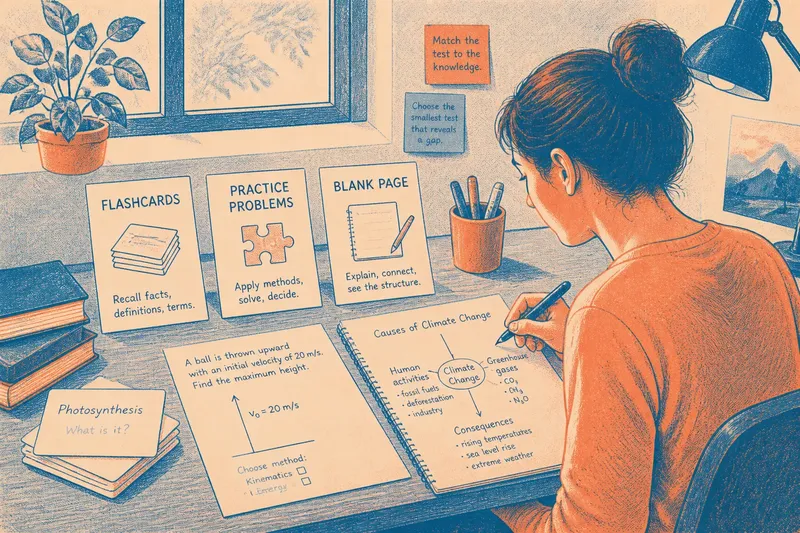
Which study method should you use when you sit down to learn: flashcards, practice problems, or a blank page? The right choice depends on what you need to recall—an isolated fact, a way to solve a problem, or a connected explanation. Each format makes a different kind of knowledge visible, so pick the one that resembles the thinking you will eventually need to do.
Match the test to the knowledge
Studying is not only about revisiting material; it is also about checking what you can produce without looking. A set of vocabulary cards can reveal whether you know terms, but it cannot show by itself whether you can use them in an argument. A worked problem can test a method, but it may say little about whether you can explain the ideas behind it.
Start by naming the thing you want to retrieve. Is it a definition, a choice of procedure, an explanation with several linked parts, or a combination? Then choose the smallest test that can expose a gap in that knowledge.
- Use flashcards for concise information with a clear prompt and answer.
- Use practice problems for procedures, decisions, and applying concepts to a situation.
- Use a blank page for connected ideas, explanations, and the structure of a topic.
These formats can overlap. A flashcard might ask you to explain a concept in a sentence, and a blank-page exercise might include a small calculation. The useful distinction is not the physical tool; it is what kind of response the tool asks you to create.
Flashcards make small pieces of knowledge visible
Flashcards work best when each prompt points to a bounded answer. A term on one side and a definition on the other can reveal whether you can retrieve the meaning without seeing it first. They are also useful for symbols, language vocabulary, names, short rules, and distinctions that are easy to confuse.
Write prompts that require a real answer rather than recognition. “What does this term mean?” is more revealing than a card that displays the definition and asks you to identify the matching term. For easily confused concepts, ask for both the definition and the feature that separates one from another.
Keep each card focused. If a prompt asks for an entire chapter, the answer becomes hard to judge; if it asks only for a fragment that has no meaning on its own, recall can become mechanical. When a card repeatedly feels ambiguous, revise the question so it signals exactly what kind of answer you expect.
Flashcards are less suited to testing whether you can assemble ideas into a coherent explanation or select a method in an unfamiliar situation. Knowing the pieces is not the same as knowing when they belong together. Use another format when the task demands relationships, reasoning, or transfer.
Practice problems reveal how you use knowledge
A practice problem asks you to do something with what you know. That might mean calculating an answer, interpreting a passage, choosing a grammar form, diagnosing an error in a sample argument, or applying a principle to a new case. The result can reveal more than whether you remember a rule: it can show whether you recognize when to use it.
Choose problems that resemble the decision you need to make, not just the page layout of the material. If the skill is selecting between two methods, include a prompt where you must decide which method fits. If the skill is carrying out a known procedure, a direct exercise may be enough to expose whether you can complete it.
After answering, inspect the route as well as the result. Ask where you hesitated, which detail you overlooked, and whether you could explain why your method fits. A correct answer reached by guessing may leave an important gap hidden; a wrong answer with a clear point of confusion gives you a useful place to review.
Practice problems can be inefficient when the real gap is a missing definition or a broad, disorganized understanding of the topic. In that case, pause and retrieve the necessary concept or map the topic before returning to the problem. More exercises are not automatically a better test if they keep avoiding the part you cannot yet explain.
A blank page shows the shape of your understanding
A blank-page test begins with a topic, question, or heading and no notes in view. Write everything you can recall, then organize it: explain the main idea, connect supporting points, and mark places where your account becomes vague. This format is especially useful for preparing to explain a topic, write an essay, teach a concept, or see whether several ideas fit together.
Do not judge the page by how full it looks. A long list can still lack the central relationship, while a compact explanation may show that you understand how the parts connect. Use headings, arrows, short examples, or a rough diagram if those forms help you represent the material accurately.
Once you have written what you remember, compare it with your notes or source material. Look for missing links, inaccurate claims, and details that seemed familiar while reading but did not come back when needed. Add corrections in a different color or in a separate section so you can distinguish recalled knowledge from information you checked afterward.
A blank page is a weak fit when the target is one precise answer or a practiced procedure. It can also feel too open if you do not know what the topic includes. Narrow the prompt—such as asking for the causes and consequences of a process—when a broad title leaves you unsure what counts as a complete response.
How should you choose a recall format?
Which method is best for definitions?
Use flashcards when you need to recall a short definition from a clear prompt. If you must also distinguish the term from a related concept, include that contrast in the answer or test the concepts together in a brief explanation.
Which method helps with applying a rule?
Choose a practice problem that requires you to recognize the relevant rule and use it in context. If you can apply the rule but cannot explain what it means, pair the problem with a short retrieval prompt or a concise written explanation.
How can you tell whether you understand a whole topic?
Use a blank page to reconstruct the topic’s main idea and its connections without notes. Then compare your account with the source and check whether the relationships are accurate, not merely whether you remembered many details.
What if a subject requires all three formats?
Use each format for the part it can expose: cards for terms, problems for application, and a blank page for the overall explanation. You do not need to force one method to cover every kind of knowledge in the subject.
Change formats when the gap changes
One study session may reveal more than one kind of gap. A blank-page explanation might show that you forgot two terms; flashcards can target those terms. A practice problem might show that you know the steps but cannot explain why they apply; write a short account of the decision before trying a different problem.
Say you are learning how a plant process works. You can make cards for the names of its parts, use a blank page to explain how those parts relate, and try a practice question that asks what happens when one part is disrupted. Each response gives a different observable signal: missing names, a broken explanation, or difficulty applying the model. The point is to let the gap determine the next format, not to follow a fixed rotation.
For a small topic, you may only need one test. If a direct question produces a clear answer and the skill is simply recall, adding a large diagram or a stack of elaborate cards is not worth the effort. Choose the simplest format that reveals the knowledge you actually need.
Make the result useful without turning it into a score
After any self-test, record the gap in plain language: “I confuse these terms,” “I can do the calculation but cannot choose the method,” or “I remember the parts but not how they connect.” That note points toward a specific review action. A vague judgment such as “I am bad at this topic” does not.
Keep the source available for checking, but put it aside while you attempt the answer. When you review, correct the content rather than rewarding familiarity: recognize what you could retrieve independently, identify what needed a hint, and choose the next prompt accordingly.
Flashcards, practice problems, and a blank page are not competing systems. They are different windows onto knowledge. Choose flashcards, practice problems or a blank page according to whether you need to recall a piece, use a method, or rebuild an explanation; switch when the next gap calls for a different view.