The First Draft Is a Material, Not a Verdict
Treat your first draft as creative material, not a verdict: sort what to keep, change, or remove, then revise with a clear next move.
How do you revise a first draft without deciding that the whole thing is either brilliant or hopeless? Treat the draft as creative material: something you can inspect, sort, and reshape. A page of rough prose, a sketch, a song demo, or a half-built idea is not a verdict on your ability. It is the stuff you have to work with.
The useful shift is practical, not sentimental. Instead of asking whether the draft is good, ask what each part is doing and what it could do better. The simple pass below helps you make those decisions before you start polishing sentences or redrawing details.
Let the draft become an object you can inspect
When you are still inside the act of making, every awkward line can feel like evidence about you. Create a little distance before revising. Save a copy, print the pages, move the sketch to a separate canvas layer, or export a rough audio mix so you can look at the work as an object rather than as a live measure of your talent.
Choose a format that makes changes easy to compare. In a document, duplicate the file or turn on suggestion mode. For a drawing, keep the original on a locked layer and work above it. For music, preserve the rough mix and make a new session version. A safe copy lets you experiment without making every choice feel permanent.
Do not begin by correcting every small flaw. Read, look, or listen through once without changing anything. Mark only the moments that catch your attention: a phrase that feels alive, a section that loses its purpose, a transition that jars, or a detail you do not understand. This first pass is a survey, not an invitation to repair everything at once.
Write down what the piece is trying to do
Before sorting individual parts, describe the draft’s intended effect in one plain sentence. It might be “show how the room changes after the argument,” “make the chorus feel restless,” or “draw attention to the contrast between the smooth shape and the scratched surface.” The sentence is a working guide, not a promise that the draft already achieves that effect.
Keep the guide specific enough to help you decide, but broad enough to allow a better idea to emerge. If you are writing a personal essay, the purpose may be to make a small choice feel consequential, not to preserve every event in the order you remember it. If you are sketching a poster, the aim may be to make one phrase readable at a glance, not to keep every decorative mark.
Say you have written a scene in which a cook prepares dinner while waiting for a sibling’s call. You might decide that the scene should show how the cook avoids naming a disagreement. That intention gives you a useful question for each detail: does it reveal avoidance, sharpen the tension, or help the scene move?
Sort each part into keep, change, or remove
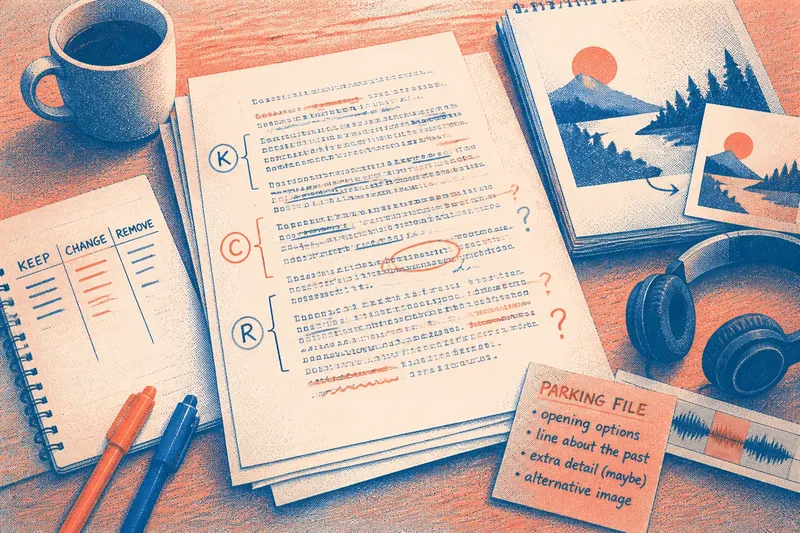
Now make one pass through the draft and assign each section, image, sound, or idea to a temporary group. Use three marks in the margin, three colors in a duplicate document, or a small table with the headings Keep, Change, and Remove. These are decisions about the current version, not permanent judgments about the material.
- Keep: The part supports the intended effect, carries useful information, or has an energy you want the rest of the work to match.
- Change: The part has a useful purpose but is unclear, misplaced, too quiet, too loud, or expressed in a form that does not fit.
- Remove: The part repeats something already clear, distracts from the piece’s direction, or belongs to a different piece.
Use a question to keep each choice grounded: “What does this part contribute?” A strong line may still need to go if it pulls attention away from the scene. A clumsy image may stay if it holds the idea the piece needs; you can work on its expression later.
When you hesitate, do not force a final answer. Put a question mark beside the part or copy it into a “parking” file. That keeps a promising fragment available without letting uncertainty stop the whole revision. Set a limit on how much material you park, though; saving every doubtful piece in a second document is just another way to avoid choosing.
Change the parts that have a job but need a better form
Start with the pieces marked Change. Name the job each one needs to do, then try a different form. A confusing paragraph may need a concrete detail before its explanation. A crowded drawing may need larger empty areas. A melody that feels flat may need a different rhythm or a clearer contrast with the surrounding section.
Make revisions at the scale of the problem. If the whole scene arrives too late, moving one sentence will not fix its structure. If a single word blurs the meaning, rebuilding the entire piece wastes attention. Work from larger choices toward smaller ones: order and emphasis first, local wording or surface detail later.
For a useful comparison, preserve the old version and make a second attempt rather than repeatedly overwriting the same line. Try two possible openings, rearrange a paragraph in a duplicate file, or sketch an alternate silhouette on a separate layer. You do not need to keep both versions. The point is to make a visible choice between different possibilities, not to polish one option before you know whether it serves the work.
Change should answer a question, not simply make the draft look busier. If a revision adds detail, ask what new effect that detail creates. If it removes something, notice whether the remaining material becomes clearer or merely thinner. A change that does not alter meaning, emphasis, rhythm, or readability may not deserve your time.
Remove material that competes with the piece
Deletion can be the most uncomfortable part of revision because the removed material may have taken real effort to create. Effort alone is not a reason to keep it in this version. If a paragraph explains what the scene already shows, a graphic element crowds the central shape, or a musical phrase repeats without adding a new turn, removing it can give the stronger material room.
Try cutting doubtful material in a copy rather than deciding in the abstract. Read the passage without the paragraph, view the composition with the mark hidden, or listen to the mix with the phrase muted. Notice what becomes easier to follow and what disappears that the piece still needs. If the result loses an essential connection, restore the material or replace it with a more focused version.
Not every appealing detour needs to be rescued into a separate project. Sometimes the cleanest decision is to let a fragment go. It is not worth the effort to archive every discarded sentence, thumbnail, or alternate sound unless you know you will use it; too much filing can turn revision into a storage project.
Make one pass at a time instead of fixing everything
Once the keep-change-remove pass is complete, choose one kind of revision for the next read. You might focus on sequence, clarity, repetition, visual hierarchy, rhythm, or transitions. A narrow focus makes it easier to notice whether a change works. It also prevents surface corrections from distracting you while the larger shape is still unsettled.
For a short story, you could first check whether each scene changes what the reader understands, then make a separate pass for dialogue that sounds too similar. For a collage, you could first adjust the position and scale of the main shapes, then review edges and texture. These are not rigid rules; choose the pass that matches the issue your survey revealed.
After a major change, experience the whole piece again. Read the document aloud, view the image at the size someone will see it, or listen from the beginning rather than replaying only the edited moment. A revision can solve one local problem while creating a new mismatch elsewhere, and the full pass helps you catch that shift.
How do you know what to revise next?
Should you wait before revising a first draft?
A short pause can help if you are still reacting to every sentence as you write it. The useful amount of time is whatever lets you return with enough distance to notice the draft’s shape; you can also create distance by printing it or switching to a new file.
What if every part seems worth keeping?
Ask what the piece would lose if you removed each part, then compare that loss with the space or attention the part uses. If several parts do the same job, keep the clearest or most vivid one and try cutting the others in a copy.
What if you cannot tell whether a passage works?
Mark the uncertainty and read the surrounding section without that passage. If the connection or effect becomes harder to understand, the material may have a job that needs a better form; if nothing important changes, it may be ready to remove.
When should you stop revising?
Stop when another pass no longer addresses a clear problem connected to the piece’s intention. You can still see imperfections; the question is whether a particular change would make the work clearer, more coherent, or more effective for its purpose.
Choose a next move you can see on the page
End a revision session by writing one concrete instruction beside the draft: “move the reveal before the explanation,” “remove the repeated shape,” or “make the second verse answer the first.” A vague note such as “make it better” gives you no useful place to begin when you return.
The first-draft-as-material approach works because it turns a broad verdict into a series of small decisions. Keep what serves the piece, change what has a purpose but needs a different form, and remove what competes with its direction. The next time a rough draft makes you hesitate, choose one visible part and ask what it is doing; that question is enough to begin revising.